
Denix M1911A1 Pistol Replica: Collector & Reenactor Review
The Denix M1911A1 pistol replica is a non-firing, full-metal historical reproduction of the iconic American military sidearm designed by John Moses Browning. Manufactured in Spain from a heavy zinc alloy, it features working mechanical action, realistic weight, and period-correct markings popular among collectors, theatrical prop masters, and military reenactors.
For history enthusiasts and living historians, finding an authentic-feeling military sidearm that complies with safety regulations can be challenging. Real vintage firearms are expensive and legally restricted in theatrical or educational settings. Denix fills this niche by producing inert replicas that capture the heft, balance, and mechanical movement of legendary weapons without firing capabilities. In this review, we examine the build quality, mechanical functions, historical accuracy, maintenance considerations, and legal guidelines surrounding this popular model.
Let us examine what makes this replica such an enduring choice for militaria collectors and display setups.
Table of Contents
What Is the Denix M1911A1 Pistol Replica?
The Denix M1911A1 pistol replica is a non-functional decorative display firearm manufactured by Denix, a world-renowned replica company based in Ciutadella on the island of Menorca, Spain. It accurately recreates the classic military sidearm adopted by the United States Armed Forces during the early twentieth century.
This model replicates the 1924 M1911A1 modification, which introduced ergonomic improvements over the original 1911 design. These updates include an arched mainspring housing, a shortened trigger with relief cuts in the frame, an extended grip safety spur to prevent hammer bite, and wider sights for faster target acquisition.
Because it is designed strictly as an inert collectible, the pistol has a solid cast barrel, a non-bored chamber, and no functional firing pin. It cannot chamber, strike, or fire live ammunition, blank cartridges, or airsoft projectiles, making it safe for handling and public display.
From what we have seen across historical reenactment units, having an inert replica that fits standard military leather holsters allows participants to portray soldiers accurately without carrying live weaponry into crowded public events.
It provides an accessible, authentic-feeling collectible for anyone passionate about American military history.
Historical Background of the Legendary Government .45
The original M1911 pistol was born out of combat experiences during the Philippine-American War, where standard-issue .38 caliber revolvers lacked sufficient stopping power against determined adversaries. Legendary firearms designer John Moses Browning developed a recoil-operated semi-automatic pistol chambered in .45 ACP, which passed rigorous military trials before formal adoption in March 1911.
Throughout World War I, World War II, the Korean War, and the Vietnam War, the 1911 served as the primary handgun for American soldiers, sailors, airmen, and Marines. Its reliability in muddy trenches, Pacific jungles, and European winters cemented its status as a legend of small arms design.
If you are interested in military protocols and official service guidelines, read our historical breakdown of leaves and passes army regulation.
The pistol remained standard issue for over seventy-four years until the adoption of the Beretta M9 in 1985, representing one of the longest continuous service lives of any military firearm in history.
Understanding this historical legacy enriches the experience of owning a faithful physical tribute to Browning engineering.
Build Quality, Materials, and Physical Dimensions
Evaluating a collector replica involves examining its material composition, hand feel, and surface finish. Denix constructs the frame and slide from Zamak, a high-density zinc-aluminum-magnesium alloy widely used for precision die casting.
This alloy gives the replica structural rigidity and substantial heft that closely approximates the weight of a genuine steel firearm.
Here are the key physical specifications that define this collectible reproduction.
Zamak Zinc Alloy Construction and Realistic Weight
The replica weighs approximately 920 grams (roughly two pounds), which sits within ounces of an unloaded real steel M1911A1 (around 1,100 grams). When you pick it up, the solid metal frame provides an immediate impression of authenticity.
The total length measures 24 centimeters (approximately 9.5 inches), matching the exact dimensional envelope of government-issue pistols. Because its external dimensions are faithful to the original blueprints, it fits snugly into vintage US M1916 leather hip holsters and M3 shoulder holsters without stretching or binding.
Zamak offers crisp casting detail, allowing manufacturer roll marks, serial numbers, and inspection stamp recreations to appear sharp across the slide and frame.
Collecting military memorabilia and historical gear is a deeply satisfying pastime. For more creative personal pursuits, see our review of truly rewarding hobbies.
The alloy does not rust like carbon steel, though it benefits from periodic light wiping to protect its painted surface from skin oils.
Grip Panels, Parkerized Finishes, and Visual Details
Denix offers the M1911A1 in several authentic finish variations. The most common version features a matte black or dark charcoal finish designed to mimic the military parkerized (phosphate) coating used during World War II.
Depending on the specific production run, the grip panels are crafted from molded synthetic composite with authentic diamond checkering, or from real stained hardwood. Both options provide solid traction in the palm and evoke the military issue appearance seen in period photographs.
Other commemorative editions feature polished nickel plating or silver finishes with faux-ivory grips, replicating presentation pieces favored by high-ranking military officers.
Traditional weaponry craftsmanship spans many centuries and disciplines. If you appreciate historical ranged equipment, check out our guide on recurve bow arrows.
Small details like the lanyard loop on the mainspring housing and the serrations on the slide help the piece look convincing even upon close visual inspection.
Working Mechanics and Moving Parts
A major appeal of Denix replicas is their interactive mechanical action. Unlike solid resin casts or static plastic models, this replica features moving internal components that simulate real weapon handling.
Manipulating the action allows users to practice drawing, cocking, and holstering drills safely.
Let us look at how the moving parts operate and what mechanical boundaries you should observe.
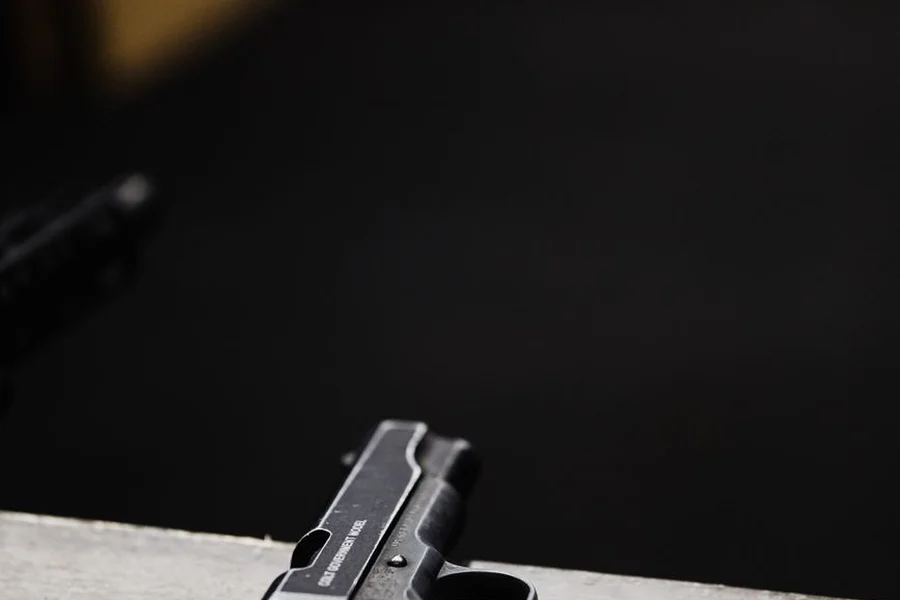
Functional Slide, Hammer, Trigger, and Removable Magazine
The slide pulls back under spring tension against a working recoil spring guide, providing realistic mechanical resistance. When pulled fully to the rear, the slide locks open on the slide stop lever, exposing the solid dummy chamber.
The external hammer features a functional half-cock and full-cock position. Pressing the trigger releases the sear with a satisfying metallic snap, allowing the hammer to fall forward against the rear frame.
Additionally, modern versions include a spring-loaded magazine release button that ejects a removable dummy sheet-metal magazine from the grip frame. The thumb safety lever clicks up to lock the slide, and the rear grip safety must be depressed into the frame before the trigger can be pulled.
These interactive features make the replica an engaging training tool for introducing new students to basic semi-automatic handgun manual of arms in controlled settings.
Field Stripping Capabilities and Critical Wear Warnings
Newer production runs of the Denix M1911A1 are designed to be partially field-stripped, allowing hobbyists to rotate the barrel bushing, remove the slide stop pin, and separate the slide from the lower frame.
However, a key sensible warning is necessary: Zamak zinc alloy is softer and more brittle than heat-treated ordnance steel. Internal parts like the sear, hammer notch, and slide stop hole cannot withstand aggressive, repeated disassembly.
Frequent field stripping causes premature wear on soft metal pins, leading to loose slide fit or mechanical failure. Similarly, constantly dry firing (letting the hammer snap down repeatedly against the frame without cushioning) can crack the internal firing plate over time.
A helpful recommendation is to place your thumb against the hammer face to ease it down gently rather than dry firing violently. Treat the replica with care, and its mechanical action will remain smooth for decades.
Replacement internal parts are generally not sold separately by the manufacturer, making gentle handling essential.
Best Uses: Reenactments, Theatrical Props, and Displays
The Denix M1911A1 serves diverse creative and educational functions across multiple entertainment and historical communities. Its inert status eliminates safety hazards associated with functioning firearms.
Understanding where this replica excels helps collectors match the product with their intended creative projects.
Here are the primary environments where this reproduction finds widespread use.
World War II and Vietnam Living History Gear
Historical reenactment groups frequently enforce strict safety rules regarding sidearms. While blank-firing weapons require specialized permits, ammunition inspections, and minimum safety distances, inert metal replicas can be carried safely in leather holsters throughout living history camps.
Reenactors portraying US Army infantry officers, paratroopers of the 101st Airborne, tank crews, or military police officers rely on the Denix 1911 to complete their authentic field uniform kit.
Because the replica has authentic weight, the leather holster hangs naturally from the web belt, matching the silhouette seen in archival military footage.
Static museum displays and veteran memorial showcases also use Denix replicas behind glass cases to honor historical milestones without maintaining active firearm inventories.
They provide an educational visual aid that allows the public to appreciate small arms evolution safely.
Film and Theater Production: Safe Inert Firearms
In independent film production, community theater, and student cinema, on-set safety is the top priority. Following high-profile industry accidents with blank-firing prop guns, many production companies mandate the use of non-firing inert replicas for all non-discharge scenes.
The Denix M1911A1 delivers realistic visual authenticity on high-definition video cameras. Actors can draw, aim, rack the slide, and eject the magazine naturally, while prop masters maintain complete peace of mind that no projectile can ever leave the barrel.
Visual effects teams can easily add muzzle flashes, smoke, and brass ejection digitally in post-production, combining complete physical safety with cinematic realism.
Its affordable price tag also allows low-budget indie filmmakers to outfit an entire squad of actors without exceeding prop budgets.
Legal Considerations and Collector Maintenance Advice
While the Denix M1911A1 cannot fire ammunition, its realistic appearance means owners must navigate legal responsibilities carefully. Knowing how to store, transport, and maintain your replica keeps you compliant with local regulations.
Simple maintenance practices also ensure the finish and moving mechanisms remain in prime condition.
Here are important legal notes and preservation guidelines for replica owners.
Non-Firing Inert Status and Public Transport Rules
Under United States federal law (18 U.S. Code Section 921), non-firing inert replicas that cannot be converted to fire ammunition are not classified as firearms. You do not need a federal background check, waiting period, or firearm transfer dealer to purchase one.
However, state and municipal laws vary. Some jurisdictions (such as New York City, California, and Chicago) regulate imitation firearms, requiring distinctive blaze-orange barrel markings or restricting display in public places.
Never carry or brandish an imitation firearm in public parks, streets, or vehicles. Law enforcement officers cannot distinguish between an inert replica and a real weapon from a distance, creating severe personal danger.
Always transport your replica in a closed case or locked box inside your vehicle trunk when traveling to reenactments or film locations.
In international regions such as the United Kingdom (under the Violent Crime Reduction Act) or Australia, owning imitation firearms may require specific club memberships, reenactor permits, or bright two-tone coloration.
Proper Cleaning, Lubrication, and Long-Term Care
Caring for your Denix replica is straightforward and requires only basic household supplies:
- Dusting: Wipe exterior surfaces monthly with a soft microfiber cloth to remove dust and fingerprint oils that can dull the painted finish.
- Light Lubrication: Apply a single drop of mineral oil or lightweight gun oil along the slide rails and hammer pivot pin once or twice a year to maintain smooth movement.
- Avoid Harsh Solvents: Never clean Zamak alloy with harsh petroleum-based bore cleaners or acetone, as these solvents strip the factory protective paint and discolor the metal.
- Dry Storage: Store the replica in a climate-controlled room away from extreme humidity. While zinc alloy does not form orange iron rust, excessive moisture can produce white zinc oxidation on bare metal contact points.
These simple preservation habits keep your collectible looking sharp and functioning smoothly for years of display enjoyment.
Frequently Asked Questions
Can the Denix M1911A1 replica fire blanks or live ammunition?
No, the replica is completely non-firing. It has a solid cast zinc alloy barrel, a blocked chamber, and no functional firing pin, making it impossible to convert or discharge live rounds or blanks.
How much does the Denix M1911A1 pistol weigh?
The replica weighs approximately 920 grams (about 2 pounds), which closely mirrors the feel and balance of an unloaded original steel M1911A1 service pistol.
Can you field strip the Denix M1911A1 replica?
Newer versions can be partially taken down by rotating the barrel bushing and removing the slide stop pin, but frequent disassembly is discouraged because the zinc alloy parts can wear down over time.
Is the magazine on the Denix M1911A1 removable?
Yes, modern production models include a functional magazine catch button that releases a removable dummy metal magazine from the bottom of the grip.
Do I need a permit or license to own a Denix replica in the United States?
Under US federal law, non-firing inert replicas do not require a firearm license or background check, though certain municipal ordinances regulate imitation firearms in public spaces.
What material is the Denix M1911A1 made from?
The frame, slide, and mechanical components are die-cast from Zamak, a heavy zinc-aluminum alloy, complemented by wooden or composite checkered grip panels.
Can you dry fire the Denix M1911A1 safely?
While the trigger releases the hammer, frequent dry firing is not recommended because repeated impacts can cause stress fractures in the zinc alloy frame over time. Cushioning the hammer with your thumb is advised.

Written by Rosella
Rosella is a self-taught digital creator with a passion for breaking down tech, lifestyle, and everyday topics into simple, easy-to-understand content. Based in Youngstown, Ohio, she brings a curious, multi-disciplinary approach to writing, covering everything from the latest tech trends to practical life hacks and personal growth insights.
Her goal is straightforward: take complicated ideas and explain them in a way that actually makes sense, so every reader, whether a total beginner or someone more experienced, walks away having learned something useful. When she’s not writing, you’ll usually find her exploring new tools, sharpening her skills, or spending time with family.
Through this blog, Rosella aims to build a community centered on real, actionable insights rather than fluff, jargon, or filler content.
